
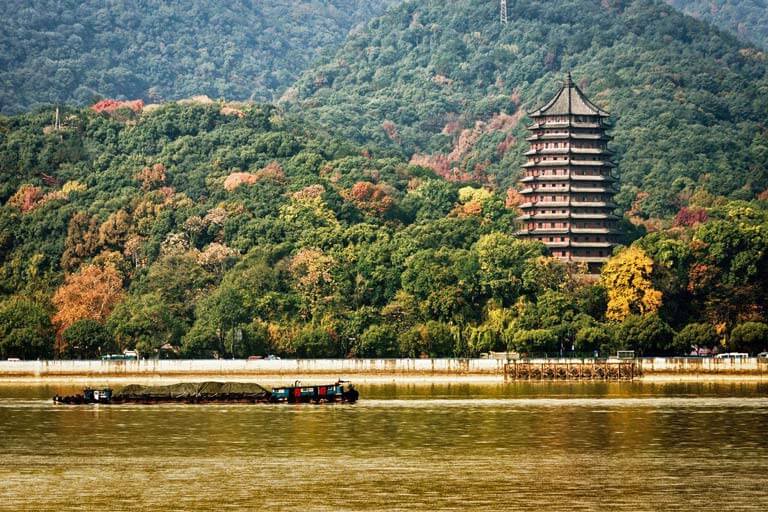
Hangzhou is proud of its long history and profound culture. For thousands of years, Hangzhou culture, as represented by cultures conceived along West Lake, the Grand Canal and Qiantang River, features a fusion of opening to the outside world and progress in creativity and innovation.
Specifically, West Lake culture has absorbed the cream of cultures of different eras, including those of the Kuahu Bridge (8,000 years ago), Liangzhu City (5,300 years ago), the Wu and Yue kingdoms of the Spring and Autumn Period (770-476 BC), Southern Song Dynasty (1127-1279), Ming and Qing dynasties (1368-1911), and the Republic of China (1912-49).
It shows the richness of landscaping, gardening, religion, architecture, celebrity, folkways, silk, tea and gourmet culture, which together reflect Hangzhou’s characteristic exquisiteness, harmony and elegance.
Grand Canal culture, which mirrors Hangzhou’s openness, inclusiveness and closeness to life, features a blending of indigenous cultural elements in water conservation, trade and commerce, local specialties, waterscapes, traditional operas and temple fairs.
Qiantang River culture, like the surging tide of the water, symbolizes the broad-mindedness and open spirit of Hangzhou residents.
Early history

The neolithic culture of Hemudu is known to have inhabited Yuyao, 100 km north-east of Hangzhou, as far back as seven thousand years ago.
It was during this time that rice was first cultivated in southeast China.
Excavations have established that the Liangzhu culture (site just northwest of Hangzhou) inhabited the area around five thousand years ago.

At that time both bronze and stone wares were used, black pottery was manufactured and the tripod vessel was used for cooking. Jade ritual articles, silk pieces and thread are also typical excavation finds, indicating the area’s prosperity in the prehistoric age.
Establishment of Hangzhou
Hangzhou city was established 2,000 years ago during the Spring and Autumn Periods (770BC-476 BC) on a site bordering Wu and Yue States.
The county of Qiantang was first established at this site under the Qin dynasty (221–207 BCE) but did not start developing until the 4th and 5th centuries CE, when the Yangtze River delta area began to be settled.
Hangzhou was made the seat of the prefecture in 589 during Sui dynasty, entitling it to a city wall which was constructed two years later. The city took on the name of the area it administered and became known as Hangzhou. Before this area was successively called Yuhang, Qiantang and Wulin.
Grand Canal

A major event that took place during the Sui dynasty was the completion of the Grand Canal, finally linking together the various sections constructed over a thousand years. Hangzhou was at the southern end of China’s Grand Canal which extends to Beijing.
On one hand, Hangzhou as the south end for the Grand Canal is not a random choice. These areas have the natural advantage of grain production, which inevitably attracted the attention of Emperor Yang of Sui dynasty who was in need to feed his court and armies. On the other hand, the Grand Canal further promoted the development of the city. The Grand Canal made it possible for Hangzhou to become a metropolis.
Bai Juyi and Bai Causeway

In the Tang dynasty, Bai Juyi was appointed governor of Hangzhou (822-824). Already being a famous poet, his actions in Hangzhou earned him the reputation of a great governor.
He noticed the farmland near West Lake depends on the water from the Lake. But due to the negligence of the former governor, the old dyke collapsed. The lake dried up, and the local residents suffered from severe drought. He ordered the construction of a stronger and taller dyke, with a dam to control the flow of water, thus providing water for irrigation and mitigating the drought problem. In the following years, the level of life of Hangzhou residents have improved.
Bai Juyi used his leisure time to enjoy the West Lake, visiting it almost daily. He also ordered the construction of a causeway connecting Broken Bridge with Solitary Hill to allow walking, instead of requiring a boat. He then had willows and other trees planted along the dyke, making it a beautiful landmark. This causeway was later named “Bai Causeway”, in his honor.

Wuyue Kingdom
Hangzhou is listed as one of the Seven Ancient Capitals of China. It was first the capital of the Wuyue Kingdom from 907 to 978 during the Five Dynasties and Ten Kingdoms period. Named Xifu at the time, it was one of the three great bastions of culture in southern China during the tenth century, along with Nanjing and Chengdu. Leaders of Wuyue were patrons of the arts, particularly of Buddhist temple architecture and artwork. Hangzhou became a cosmopolitan center, drawing scholars from throughout China and conducting diplomacy with neighboring Chinese states, Japan and Korea.
Su Dongpo and Su Causeway
In 1089, while another renowned poet Su Shi (or Su Dongpo… yes, yes, he invented famous Dongpo Pork) was the city’s governor, he used 200,000 workers to construct a 2.8 km (1.7 mi) long causeway across West Lake made of mud dredged from the lake bottom. . This causeway is now called the Su Causeway.

The lake was once a lagoon tens of thousands of years ago. Silt then blocked the way to the sea and the lake was formed. A drill in the lake-bed in 1975 found the sediment of the sea, which confirmed its origin. Artificial preservation prevented the lake from evolving into a marshland. The Su Causeway built by Su Shi, and the Bai Causeway built by Bai Juyi, were both built out of mud dredged from the lake bottom.
Lin’an – Capital of Southen Song dynasty


Hangzhou was chosen as the new capital of the Southern Song dynasty in 1132, when most of northern China had been conquered by the Jurchens in the Jin–Song wars. The surviving imperial family had retreated south from its original capital in Kaifeng after it was captured by the Jurchens in 1127. Emperor Gaozong moved to Hangzhou in 1129.
The Song government intended it to be a temporary capital, but over the decades Hangzhou grew into a major commercial and cultural center of the Song dynasty, rising from being a middling city of no special importance to being one of the world’s largest and most prosperous.
Once the prospect of retaking northern China had diminished, government buildings in Hangzhou were extended and renovated to better befit its status as a permanent imperial capital. The imperial palace in Hangzhou, modest in size, was expanded in 1133 with new roofed alleyways, and in 1148 with an extension of the palace walls. Unfortunately, the original palace didn’t survive the Mongol attack in the future. In 2020 the palace was restored under the name Deshou Palace.

From 1138 until the Mongol invasion of 1276, Hangzhou remained the capital of the Southern Song dynasty and was known as Lin’an. It served as the seat of the imperial government, a center of trade and entertainment, and the nexus of the main branches of the civil service. During that time the city was a gravitational center of Chinese civilization: what used to be considered “central China” in the north was taken by the Jin, an ethnic minority dynasty ruled by Jurchens.
There was trade, obviously, facilitated by the canal; there was entertainment, lots of entertaiment that could be found in places such as tea houses and restaurants; there was also all kinds of civil services. Government would even offer public clinics and paupers’ graveyards, not to mention schools reside in Buddhist and Daoist temples. With the growth of commercial, the installment of civil and military personnels, and the arrival of northern refugees, it is believed that Hangzhou was the largest city in the world at that time.
Mongols, Khinzai and Marco Polo

Hangzhou was besieged and captured by the advancing Mongol armies of Kublai Khan in 1276, three years before the final collapse of the Southern Song. The capital of the new Yuan dynasty was established in the city of Dadu (Beijing), but Hangzhou remained an important commercial and administrative center for their southern lands.
Yuan China was very open to foreign visitors, and several returned west describing Hangzhou, now called Khinzai, as one of the foremost cities in the world.
The Venetian merchant Marco Polo supposedly visited Hangzhou in the late 13th century. In his book, he records that the city was “greater than any in the world” and that “the number and wealth of the merchants, and the amount of goods that passed through their hands, was so enormous that no man could form a just estimate thereof.” This European traveller was simply overwhelmed by the city, calling it “the city of paradise”, and was amazed by its prosperity.

Ming and Qing Dinasties
The city remained an important port until the middle of the Ming dynasty era, when its harbor slowly silted up.
Under the Qing dynasty, it was the site of an imperial army garrison.

In 1856 and 1860, the Taiping Heavenly Kingdom occupied Hangzhou. The city was heavily damaged during its conquest, occupation, and eventual reconquest by the Qing army.
Hangzhou in 20th century
Hangzhou was ruled by the Republic of China government under the Kuomintang from 1927 to 1937 and 1945 to 1949.
On May 3, 1949, the People’s Liberation Army entered Hangzhou and the city came under Communist control.
After Deng Xiaoping’s reformist policies began in the end of 1978, Hangzhou took advantage of being situated in the Yangtze River Delta to bolster its development. It is now one of China’s most prosperous major cities.

Hangzhou nowadays
In 21st century Hangzhou has become globally well-known since hosting the G20 Summit in 2016.
Hangzhou is the political, economic, cultural, educational, transportation, and financial center of Zhejiang Province.
The 2022 Asian Games were held in Hangzhou.
